




















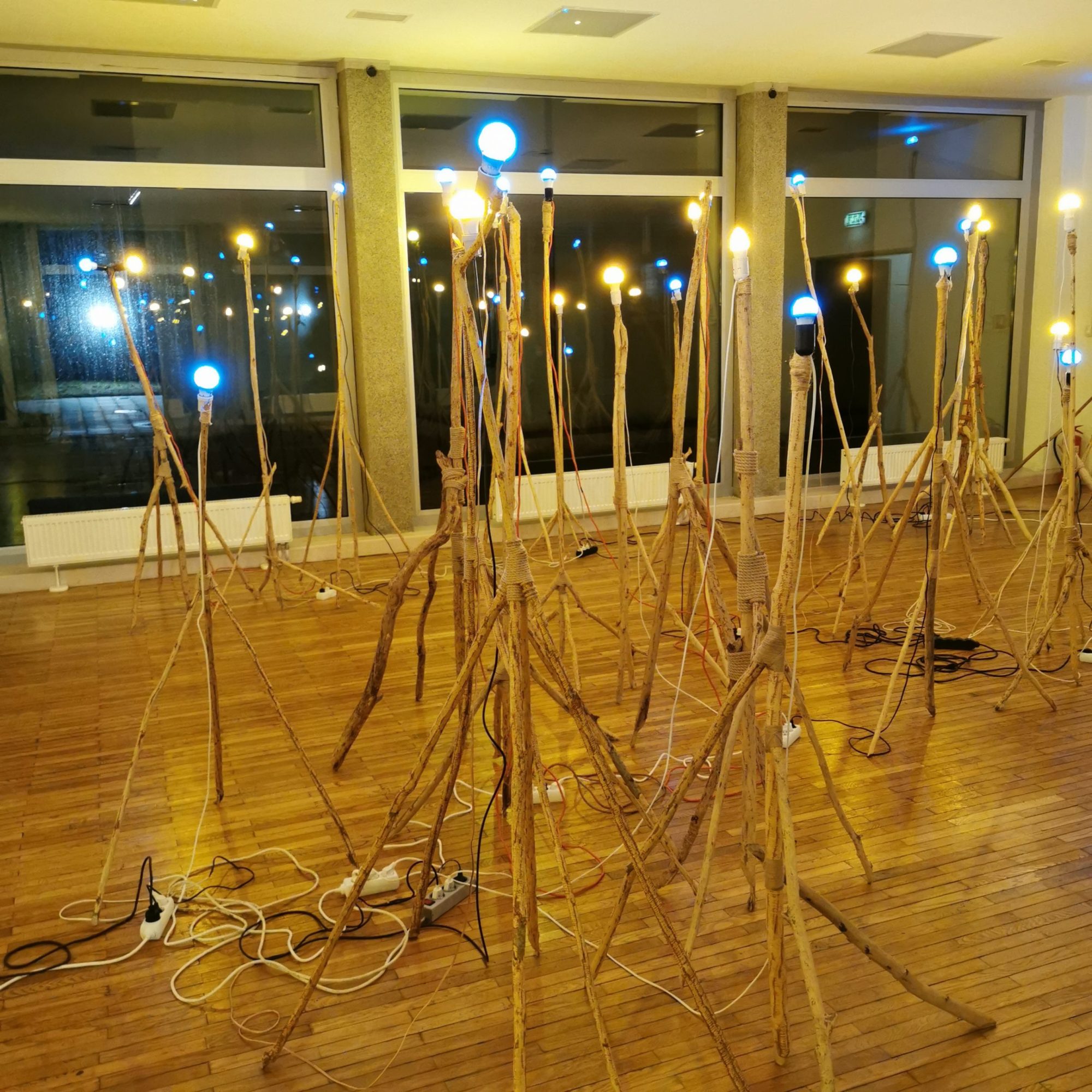
The installation consists of beaver-chewed logs found in the forest, tied with natural fiber, twisting cords, and at the top are hard-to-recycle LED bulbs. The latter seems to deny all the efforts made by the author to create a sustainable piece of work. The artist uses the primitive tying technology often found in crafts to tie the ends of the cord. Until recently, LED bulbs were an expensive and hardly affordable innovation for everyone. As the author remembers, you may have learned about LEDs from the media, but over time, the innovation has become a common, easily accessible technology that has become perhaps the main source of light these days (except the Sun). In this installation, the work of art is interpreted as a product of visual culture, in which the views of the creator and other actors in the field of culture intertwine. An installation or part of it in a different environmental context can be treated either as a work of art or as an interior detail. Apparently, the unifying multi-layered idea – remains essential – is a play in desperation.
Tomas Daukša (DOB 1988) is an artist of the young generation, who recently (in 2019) was awarded Doctor of Fine Arts degree at Vilnius Academy of Arts. Since 2009, he has been an active participant in group exhibitions in Lithuania and elsewhere, and has held several solo exhibitions. His works has been presented in international contemporary art fairs and important art institutions (Contemporary Art Centre (Vilnius), National Gallery of Arts (Vilnius), Klaipeda Culture Communication Center). In 2013, Dauksa became a recipient of Ary Stillman fellowship.
In his work Daukša is interested in the relations between various systems and their elements. The artist either creates or observes the already existing systems – electronical, biological, and communal. With a scientist’s dedication he documents the phenomena that are taking place there, creates models and mock-ups, experiments with physical phenomena (sound and light). Yet, unlike scientists, the artist does not seek objective proofs of a statement or a fact. His research always leaves some space for mystery, omission, imagination and chance. As a researcher, he quite frequently does not keep the distance from a research object, and affects the systems that he creates or replicates, thus influencing the course of the research. The viewer also often gets involved in the play with facts and fiction. Thus the result is often unpredictable, different each time and not necessarily important – attention is focused on the process itself, and the temporal and cyclical character of the research, action etc. is emphasised.
Having started to study painting, today Dauksa has expanded the range of his work and presents his research in various forms – sculpture, paintings, installations, photographic documents and schemes. Despite his research methods based on scientific logic, the artist dedicates much attention to the visual aspect of his works: volumes and forms, proportions, materiality and spatial arrangement. His work combines an attractive aesthetic form and conceptual contents.
Curator Skaistė Marčienė