Skip to content
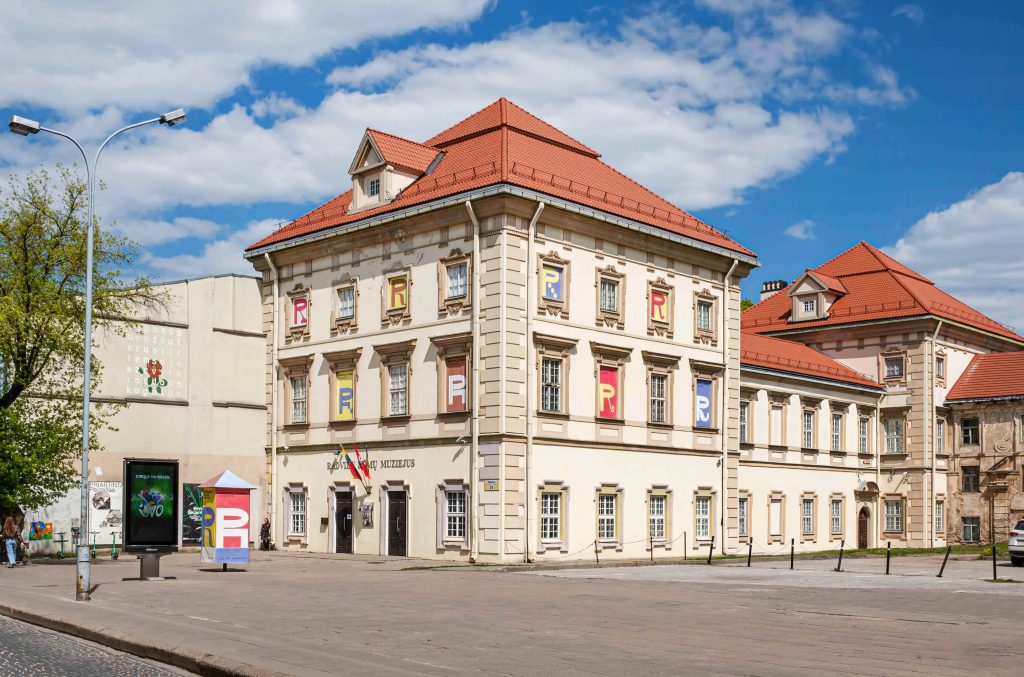
Radvilų rūmų dailės muziejus

Radvilų rūmų dailės muziejus

Ekspozicijos

Protest Art: The Rebels of the Soviet Era. From the collection of Vladimir Tarasov donated to the Lithuanian National Museum of Art

  Photo by Ugnius Gelguda All the artworks presented in the exhibition became the property of the Lithuanian National Museum of Art on 6 January 2020, when the world-famous jazz musician and artist Vladimir Tarasov donated his five-decades’ worth of collection. The exhibition presents the works of forty artists who worked under the conditions of ideological dictate, censorship and restricted freedom of movement during the 1960s and 1980s in the Soviet Union. The creative works of the Moscow Conceptualists and the Lithuanian Silent Modernists are central to this collection. As different as they are in terms of artistic expression, they all share a common quality: defiance towards the prevalent ideological and aesthetic attitudes of their time and an effort for creative freedom. At the same time, this serves as one of the few attempts to present well-known Lithuanian Silent Modernists alongside their ‘brothers-in-arms’ who are lesser-known in Lithuania – creators of Soviet-era unofficial art from Russia, Ukraine, Latvia, and Estonia. Director General of the LNMA, exhibition curator Dr Arūnas Gelūnas Vladimir Tarasov decided to donate the collection to the Lithuanian National Museum of Art in the city of Vilnius where the set was located. The geographic location Vilnius is also largely responsible for creating a unique blend of Russian and Baltic artists, one of the most obvious characteristics of this collection. For decades, this distinctive blend has served as the object of aesthetic pleasure for Tarasov, the collection’s owner. Such logic of generosity has been paid forward by donating his collection to the public institution where anyone and everyone can see it. Many of the works can be seen as aids to better understand visual culture. For example, Erik Bulatov and Ivan Chuikov both have pieces that are instruments for seeing ideological codes in art and culture. Personal friendship defied the constraints of the dominating economy beneficial to creating a collection that had no place in a socialist country. It needed to wait for its moment to resurface so that its historical legacy could be worthfully re-evaluated. This procedure opened the door for the museum; the best place where the collection can continue to contribute to the emancipation of its viewers. Daniel Muzyczuk, curator at the Museum of Art in Łódź (Poland) Curator dr. Arūnas Gelūnas Coordinator Justina Augustytė Architects: Petras Išora, Ona Lozuraitytė Graphic designer Vytautas Volbekas Organiser The Lithuanian National Museum of Art The project is financed Lithuanian Council for Culture
More about the exposition

Vibrant Old World Profiles. 16th to 19th-Century  Western European Painting from the Collection of the Lithuanian National Museum of Art

The collection of 16th to 19th-century Western European painting of the Lithuanian National Museum of Art is fragmentary and multifaceted, having formed in the 20th century from various collections and individual art works that for various historical reasons lost their original owners. The exhibition presents the most valuable part of the museum’s collection encompassing works of various Italian, Spanish, Dutch, French and German painting schools and genres. Next to the paintings of unknown, or as yet unidentified authors, the audience can expect to see impressive works by Bartholomaeus Spranger, Cornelis van Haarlem, Salvator Rosa, Lodovico Carracci, Giuseppe Maria Crespi, Meindert Hobbema, Antonio Bellucci and other well known Western European masters. The exposition consists of ten thematic sets of paintings, ten sections that iconographically and associatively connect the works. We suggest starting the museum walk from the green hall of The Natural Elements, then continue to the spaces saturated in classic red displaying the Labour and Feasts rooms, after that, proceed to the silent stories narrated by centuries-old works conveying  the themes of Choices and Oaths, Labour, Lust and Temptation, and Fights, none of which have not lost their relevance even today. Then, we invite you to walk further ahead, continuously looking through the ‘windows’ revealed by the paintings on the plush walls echoing the atmosphere of the old Salon. Upon reaching the Journeys and Discoveries hall, the exhibition route will guide visitors to the museum spaces dedicated to the contemplation of Religious Passion, Visions and Meetings, and Sleep, Vigil, Death. Exhibition Curator dr. Tojana Račiūnaitė Curators: dr. Tojana Račiūnaitė, Joana Vitkutė Architects IMPLMNT architects Architect-coordinator Mindaugas Reklaitis Graphic designer Vytautas Volbekas Coordinators: Justina Augustytė, Viltė Visockaitė The project is financed by Lithuanian Council for Culture Sponsor BTA Baltic Insurance Company Media partners: UAB „JCDecaux Lietuva“, VšĮ Lietuvos nacionalinis radijas ir televizija
More about the exposition
Archive

Chambers of Radiance by Emilija Škarnulytė

Emilija Škarnulytė’s solo exhibition Chambers of Radiance is centred on one of the artist’s most famous works, t ½, which won the 2019 Future Generation Art Prize of the Kyiv Centre for Contemporary Art. Exploring posthumanist mythology, the impressively large audiovisual installation draws attention to issues of the nature-human interface, climate change and nuclear energy – topics that are particularly relevant today. The work t ½ is a fictional visual meditation on contemporary science from an archaeological future perspective. Reflecting on Škarnulytė’s work, cultural researcher Alison Sperling asks: “What would an alien archaeologist tell about our history if confronted with the atomic and technological ruins of the 21st century?” The exhibition invites us to experience the world through the futuristic lens of such an alien archaeologist. Part of the piece was shot in Lithuania, at the decommissioned Ignalina Nuclear Power Plant, and part in the canals of nuclear submarines in the Arctic Circle. The video also captures the Super-Kamiokande neutrino observatory in Japan and the particle accelerator at CERN in Switzerland. The installation is complemented by two works, Future Fossil I and Future Fossil II, featuring computer-graphic images of the over-the-horizon radar Duga and the neutrino observatory Super-Kamiokande. Architect Linas Lapinskas Architect-coordinator Aleksandras Kavaliauskas Graphic designer Vytautas Volbekas Sound Jokūbas Čižikas Coordinator Viltė Visockaitė Organiser The Lithuanian National Museum of Art Partners: Vilnius University Faculty of Philosophy, Berlin Institute of Technology Sponsor UAB Ramirent Media sponsor JCDecaux The project is financed by Lithuanian Council for Culture
More about the exposition

Naujienlaiškio prenumerata

Veiklos ir paslaugos

Apie mus

Siekiame tapti įkvėpimo šaltiniu, kuriančiu bendravimo, emocinės gerovės, savęs ir pasaulio pažinimo aplinką. Tikime, kad menas yra vertybė, turinti didžiulį edukacinį potencialą, teikianti pažinimo džiaugsmą ir gyvenimo prasmės suvokimą.

logo

Apsilankyk Radvilų rūmų dailės muziejuje

Bilietai
Logo