






















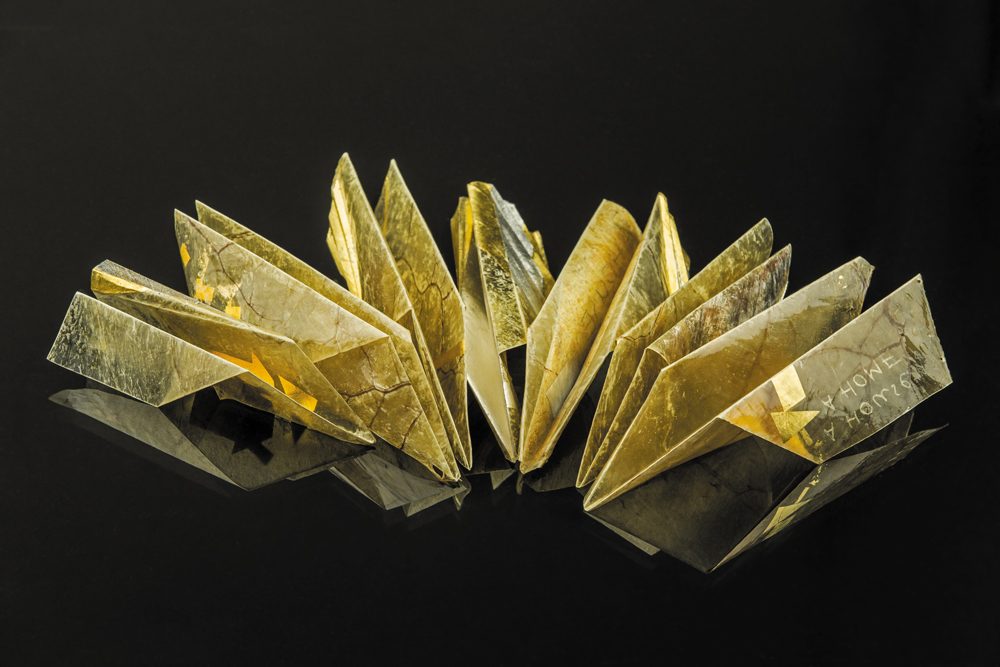
As a result, in her ninth solo exhibition, the artist changes her thinking and adjusts her dimensional approach. Inspired by early toys made from pig bladder and peas, she creates modern objects. Pig bladders become monumentally shaped rattles turned into jewellery. Bladder, once an animal organ, becomes a material for jewellery; once a part of a pig’s body, now it is turned into a conceptual human body adornment. Leather, tanned by the artist herself, is gold plated and turned into organic brooches and objects. As parchment, this material has similarities to paper, easily gives in to being folded into brooches, harmonicas or planes gracefully covering the body. In Kazlauskaitė’s work, even the intestines are turned into an aesthetic element of jewellery, enveloping pieces of amber and organically binding them into one whole.
Organic games speak about coexistence. About the fact that we are all a part of nature which sometimes steps out of line, and can be punished. It speaks about the fact that man plays with nature until its patience is lost and reminds us that we are just powerless toys in the hands of the natural elements. About the fact that we are each other’s toys. We are all one, and sometimes our bodies, instead of decomposing, go on living in different forms. What used to be unaesthetic, animalistic, organic here turns into components of modern jewellery, hidden like inclusions between organic peat briquettes and covered with domes of organic glass. And not accidentally so. Intestines and parchment, bladders and amber, a mineral of organic origin – all this, as Karina Kazlauskaitė puts it, speaks about organically perceived life.
Curator Jurgita Ludavičienė
Coordinator Regina Makauskienė
Architect Vladas Balsys
Sponsors: Klasmann-Deilmann GmbH, Vilnius Academy of Arts
Media sponsor LRT


