





















Juzefa Katiliūtė was born on 8 December 1916 in Igliauka, Marijampolė District, into the family of intellectuals.
Encouraged by her brother, she enrolled in the Kaunas Art School. “As I was a reticent child, he thought that he had found a language for me – a language of colours and forms”, the artist remembers.
Katiliūtė finished school in 1940 and was accepted into the Vilnius Academy of Arts where she studied from 1940 to 1943. There, she also chose professor Justinas Vienožinskis’s painting class. At the Academy she met the student of sculpture Gabrielius Stanulis, and married him on 22 May 1942. With the second Soviet occupation approaching, in 1944 the family fled from Lithuania. Finally they reached Switzerland, a country beautiful for tourists but unfriendly to refugees from different war-devastated places who flooded there Katiliūtė entered the Geneva School of Fine Arts and graduated from it in 1948 with a diploma and a grant, and was even assigned a small studio.
Having waited for citizenship for fifteen years, the artist received it as late as 1966, much later than her husband. The status of war refugee and citizenship helped her to get established in the new country. However, Katiliūtė always fostered her Lithuanian roots and emphasised her nationality. The hardships of settling in the new country and disagreements weakened the family and the marriage fell apart, but both artists preserved a strong mutual bond.
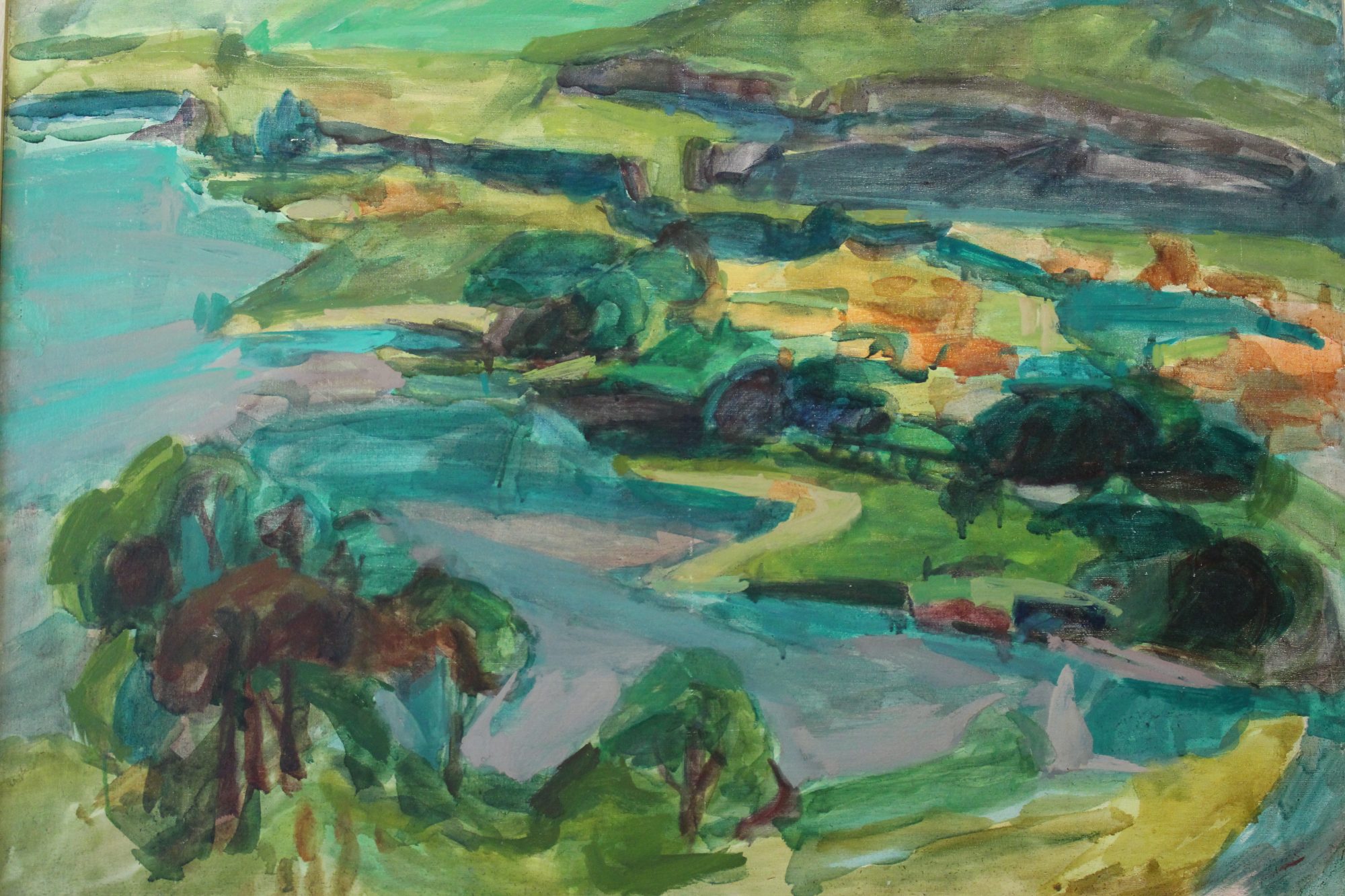
Katiliūtė’s work is considered modernist. She managed to direct her painting towards abstraction and also to retain the narrative. Acclaimed by critics for her originality and colours, the artist is often described as a creator of heavens and earth, dawn and dusk, visible and invisible, tangible and intangible worlds.
Katiliūtė’s first creative return to Lithuania took place in 1988, when she participated in an exhibition of Lithuanian artists in exile in Vilnius. In 1994, a solo exhibition of her paintings, drawings and prints was opened at the Lithuanian Art Museum. Katiliūtė was of slender build and frail health. Yet she lived to almost 93 years and continued to paint until the last days of her life. The artist died on 17 November 2009.
The Universal Meanings in the Creative Work of Gabrielius Stanulis
The creative work and artistic pursuits of the painter Gabrielius Stanulis (1915–1999) reveal and visualise his creative world, involving not only dynamic shapes and an expressive vocabulary of light, lines and colours, but also the complicated path towards a philosophical understanding of the world, marked by a strive towards spiritual growth throughout his life.
In the 1970s in Switzerland, critics presented G. Stanulis as one of Geneva’s brightest modernists, who had created the memorable red brick wall, and as one of the most unique artists, who had found a particularly interesting way of joining light, colour and philosophical thought in his work.
Gabrielius Stanulis was born on 21 October 1915 in the town of Kalvarija in Marijampolė volost, Lithuania. His religious family was not particularly rich but owned a farm that provided sufficient means to get by. Gabrielius was the second son out of three.
After graduating from primary school in Kalvarija in 1931, G. Stanulis was sent out to an industrial school in San Benigno Canavese, Italy, not far from Turin. After returning to Lithuania in 1937, G. Stanulis worked for a chemical company studying acids. But with the beginning of the Soviet occupation in 1939, he was forced to move to Vilnius, where he entered the Vilnius Academy of Arts to study sculpture. He was involved in the resistance movement. G. Stanulis then met Juzefa Katiliūtė and they soon got married to avoid exile. However, he still got arrested later on and was sent to a forced labour camp. After being moved to a different camp in Poland, he managed to escape in 1944 and him and his wife moved to Vienna, where her sister was acting in a theatre. From there, they moved to Dusseldorf and reached the Swiss border, where they began working for local farmers. Once in Switzerland, they were moved to the Yverdon refugee camp. G. Stanulis never came back to Lithuania after that and all his friends were gone.
Fate was more favourable to G. Stanulis: he was given a small studio where he could work and in 1956, he had his first solo exhibition. He then became noticed as a talented sculptor and received an invitation to teach at the Geneva School of Fine Arts. Soon he was entrusted with the task of reorganising the school into a university-level institution as it became joined with the State University of Geneva. Around 1952, G. Stanulis met the French Orientalist and interpreter Jean Herbert (1897–1980) and was inspired by him to study the Hindu works “Vivacious Spirituality” (“Spiritualité vivante”) and the writings of the Indian philosopher Sri Aurobindo (1872–1950). He delved deep into the meaning of human existence and became interested in psychology: in 1956–1960, he studied under the famous Swiss psychologist Jean Piaget (1896–1980) in the University of Geneva. He became the professor of the Sculpture Department, which he himself founded and led from 1963 to 1982, i.e. until his retirement.
Gabrielius Stanulis died on 30th August 1999 at his home in a village in Cartigny, which is also where he was buried.
Curator Nijolė Nevčesauskienė


