























Her watercolours represent a unique and significant contribution to the tradition of non-professional Lithuanian art in the second half of the twentieth century.
Born in 1927 into a peasant family in the village of Antšvenčiai (Smalininkai rural municipality, Pagėgiai County), Meškaitytė was profoundly shaped by her native environment, which informed both her personality and her artistic vision. Life in the East Prussian countryside at that time was marked by the robust German economy, a distinct mentality, and a Protestant cultural tradition. However, her early aspirations and dreams were abruptly interrupted by the Second World War, an event that would decisively alter the course of her life. In October 1944, as the front approached, the Meškaitis family, like many others in the region, fled to East Prussia. While staying at the manor of Baron von Wangritten in Bartenstein near Königsberg, Lida, driven by a deep longing for her homeland, began painting her native homestead surrounded by trees on greeting cards. In March 1945, during the family’s return journey, she suffered a severe injury when a collapsing wall of a bombed building struck her, leaving her permanently disabled. This tragedy, along with the hardships that followed, became a defining turning point in her life. It unlocked her creative potential and guided her toward a life in art, through which she sought to affirm the beauty of her native land in painted form. Her miniatures meticulously depict the landscapes of Antšvenčiai, the intimate surroundings of her family homestead, scenes from former Lithuania Minor, and portraits of loved ones. Her work is distinguished by a sensitive gaze, a lyrical worldview, and a profound attentiveness to her environment. She was deeply attuned to the subtlest shifts in nature’s moods, responding to its vast diversity and constant change, and patiently translating these impressions onto small sheets of paper.
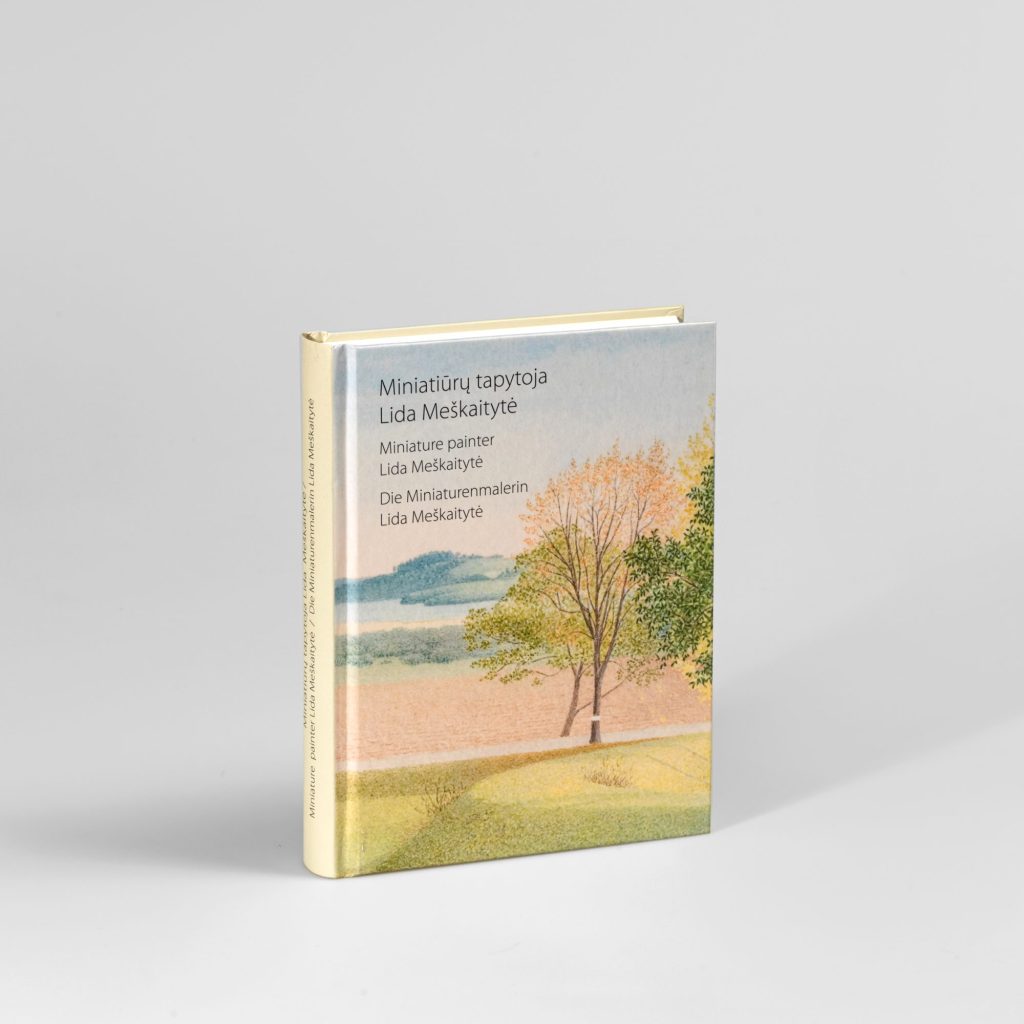
This publication provides a concise overview of the artist’s life and traces the key stages of her creative development. Illustrated with 292 reproductions – from her early works and drawings to her most accomplished landscape miniatures – the album allows readers to follow the evolution of her artistic language, stylistic shifts, and emerging creative directions. The artist’s legacy, bequeathed to the state by her will, has been preserved at the Lithuanian National Museum of Art since 1995. Her oeuvre spans 44 years, from 1944 to 1988, and comprises 765 works in total. This includes approximately 375 watercolours – landscapes, portraits, self-portraits, several interiors and still lifes, greeting cards, and early pieces – as well as more than 300 pencil drawings and sketches, along with two published postcard series. The most significant part of her body of work consists of watercolour landscape miniatures, which are unique within Lithuanian art. These works showcase her distinctive watercolour technique and remarkable precision of execution. They are inspired by the ever-changing, diverse beauty of her native land across the seasons.
The text of the publication, authored by Daiva Beliūnienė and Marija Kuodienė, is presented in Lithuanian, English, and German.
Editors: Daiva Beliūnienė, Marija Kuodienė
Copy editor Leta Gaubaitė
Translation by Aušra Simanavičiūtė, Markus Roduner
Designer Loreta Uzdraitė
Published by Lietuvos dailės muziejus. Vilnius, 2018
Printed by UAB „Standartų spaustuvė“
Edition of 500
Project partially financed by Lithuanian Council for Culture


